Paper on speech induced entrainment in Progress in Neurobiology
Paper from one of my PhD projects with Stephan Bickel and Ashesh Mehta was published in Progress in Neurobiology! “Neural entrainment by speech in human auditory cortex revealed by intracranial recordings” We tried to give a more nuanced picture of speech perception using iEEG. Two hypotheses emerged as potential mechanisms in understanding how we perceive speech:
- Neural entrainment of oscillations has amassed much attention due to its flexibility and rich background
- Evoked response hypothesis explains what we see as a combination of responses to speech
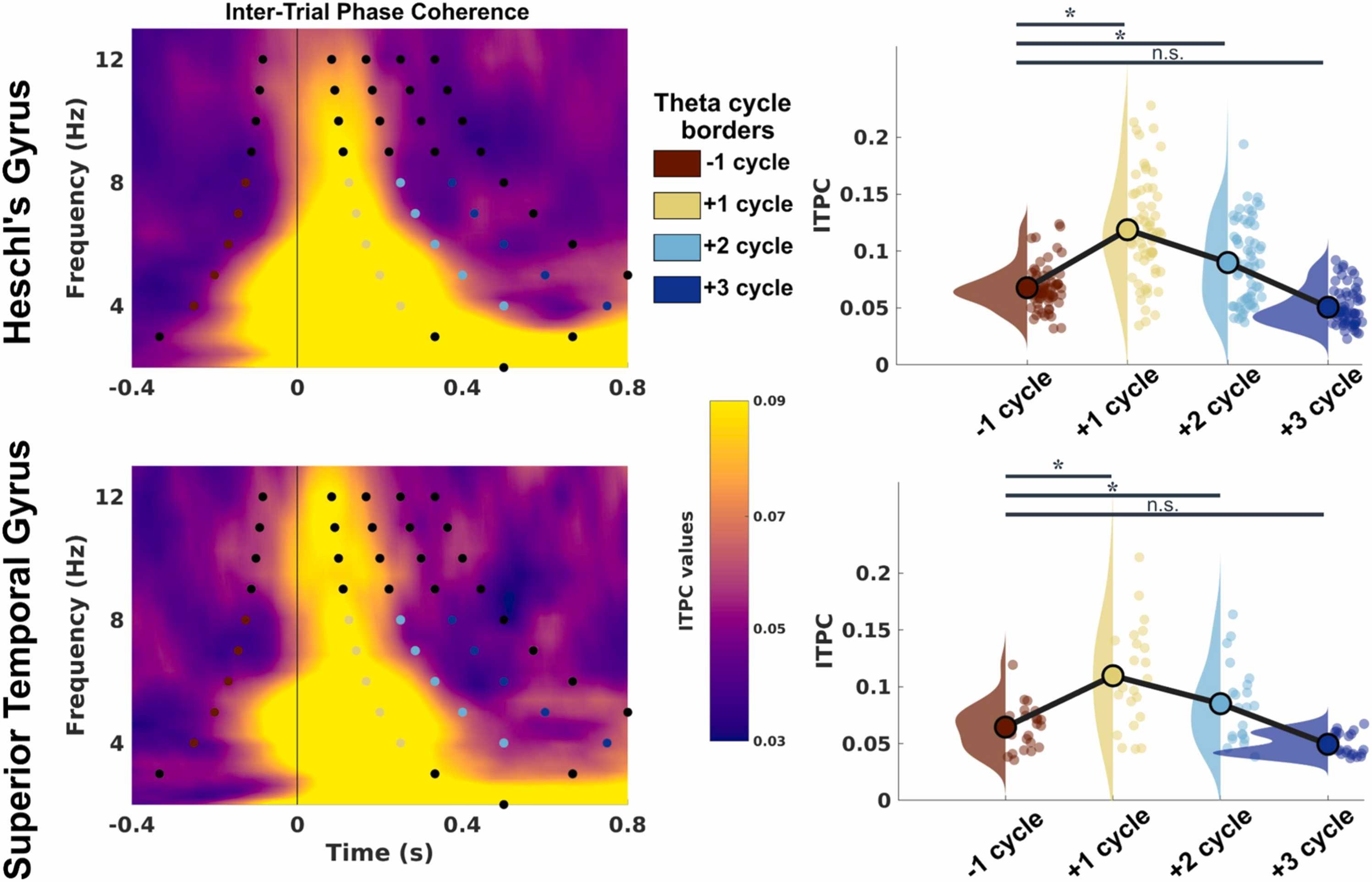
One elegant way to answer the difference is by looking at the phase alignment after an evoked activity as elegantly proposed by Oganian et al. We tried to replicate these findings using intracranial EEG as there are several differences between MEEG and iEEG. Our participants (I don’t like calling them patients since they give their best effort for science without return) listened to ~45min of speech stimuli. We initially replicated that both Heschl’s gyrus and superior temporal gyrus have cerebro-acoustic coherence with speech in the theta range. But both HG and STG respond to the acoustic edge earlier than acoustic peak. As expected, since acoustic edges lead the acoustic peaks. Then, we looked if the acoustic edge locked phase alignment (inter-trial phase coherence) lasts more than two cycles for events that are at least 800ms apart. We found ITPC lasts 2 cycles of theta band above the phase concentration that happens right before an acoustic edge. If the phase concentration happened just because of the evoked potential, the 2nd cycle would have gone back to baseline values. However, what we see is that the ITPC stayed higher than the phase concentration happened before the evoked potential. This effect was localized to HG in theta and alpha bands and to STG in theta band only. We believe our findings support the neural entrainment of oscillations during speech perception by acoustic edges. This is just another drop in the bucket of the vast literature on the neural oscillations. There is more to look and much to debate.
Learned a lot thanks to my wonderful co-authors, Akash Mishra, Noah Markowitz, Elizabeth Espinal, Menoua Keshishian, Nima Mesgarani, Charles Schroeder and my PhD advisors Stephan Bickel and Ashesh Mehta.