Minimally invasive electrical stimulation in speech perception in Hearing Research
Paper from one of my PhD projects with Stephan Bickel and Ashesh Mehta was published in Hearing Research! “Dynamic, minimally invasive electrical brain stimulation improves speech perception” This was a project we started to use available tools and stimulation methods in the way to improve speech perception. Current noninvasive electrical brain stimulation (EBS) methods are limited due to the regional specificity and they are susceptible to current shunting through the skin. Alternatively, invasive EBS methods generally disrupt the ongoing perception as in functional stimulation mapping in epilepsy patients.
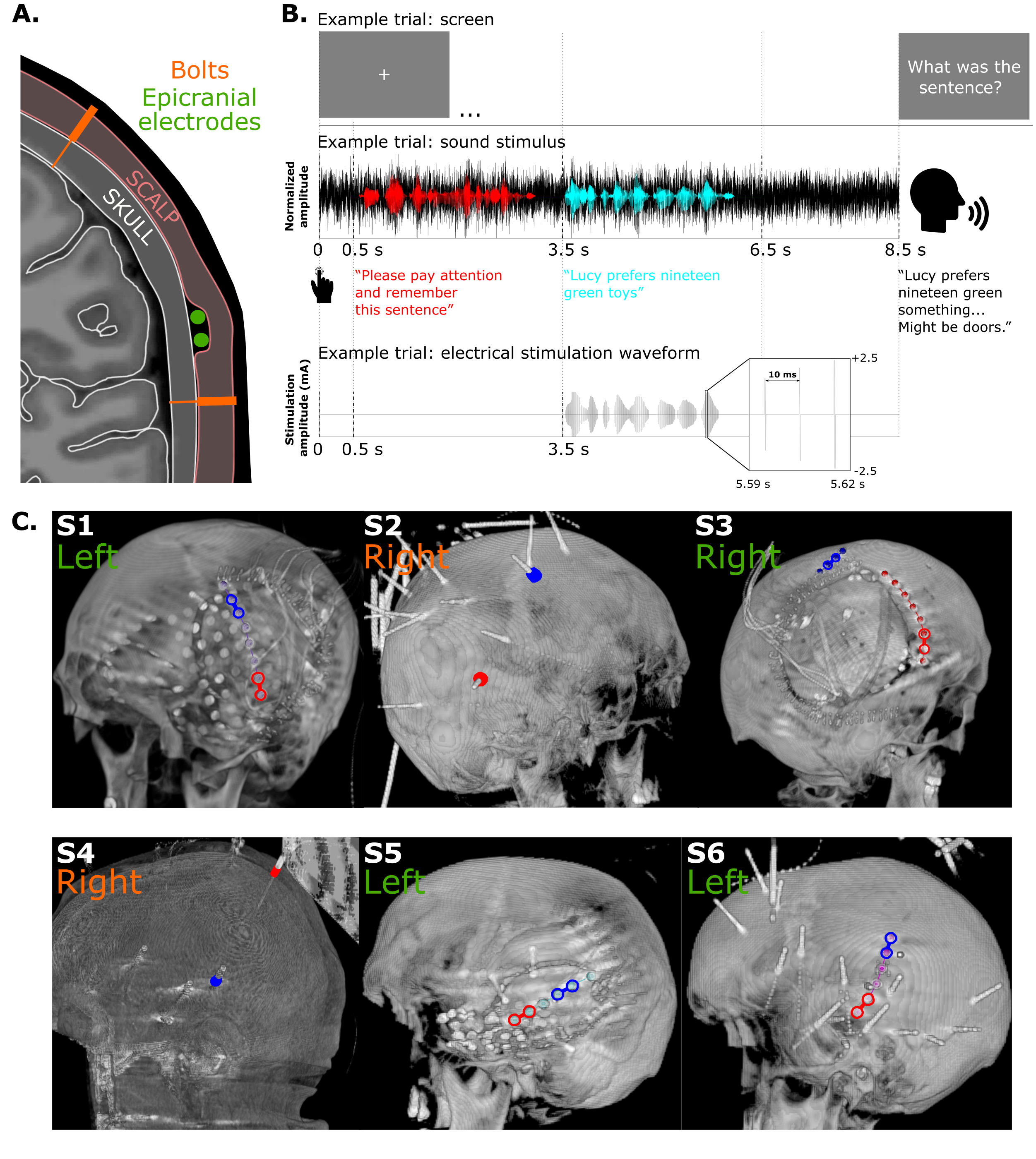
We utilized the already-implanted bolts and epicranial electrodes to apply electrical stimulation during a speech perception task in epilepsy patients undergoing invasive EEG monitoring. Participants monaurally listened to pseudo-randomly presented sentences from matrix sentence speech-in-noise task in 3 conditions: no-stimulation, 50 ms, or 200 ms stimulation lag relative to sentence onset. EBS parameters were 100 Hz, biphasic, amplitude-balanced, square-wave pulses where the amplitude (1-6 mA) was modulated by the ongoing speech envelope.
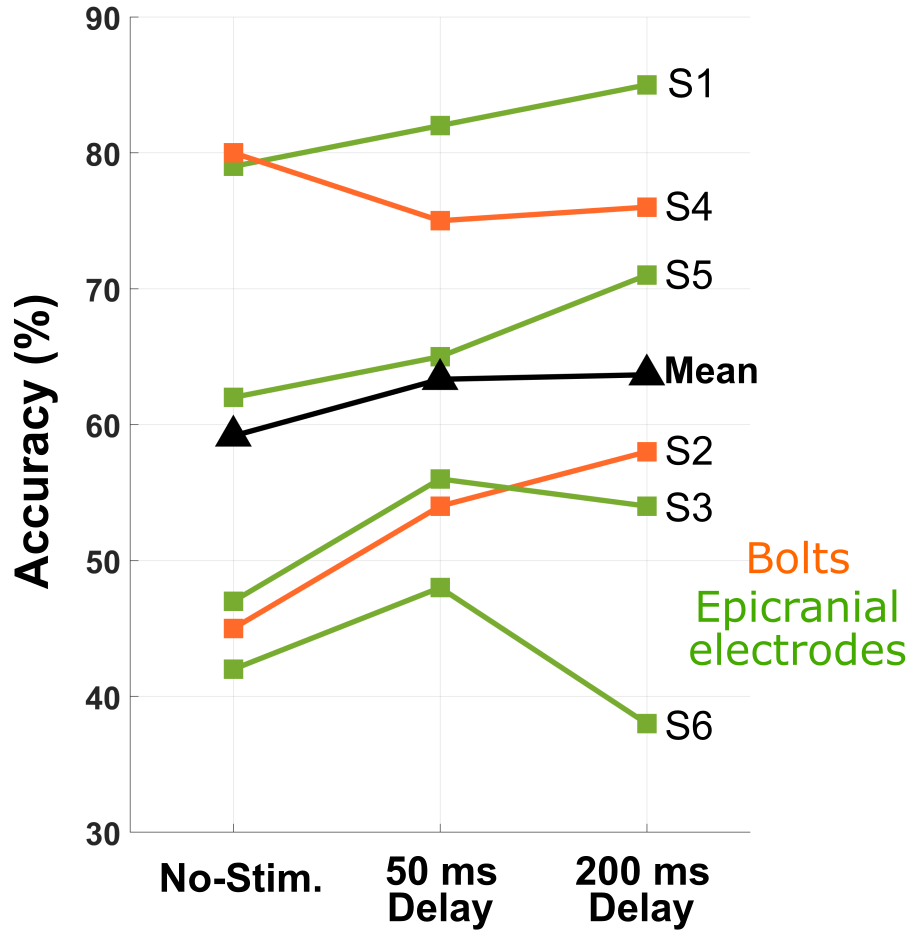
Accuracy in the task improved in 5 of 6 sessions while not reaching significance across sessions possibly limited due to the limited number of sessions and trials (p=0.087 and 0.068 for 50 ms and 200 ms delay, linear mixed-effects model). In 5/6 sessions, there was increased accuracy with 50 ms delay, and in 3 of those, there was further improvement with 200 ms delay.
First, the safety and feasibility of using epicranial electrodes and bolts as electrical stimulation contacts was shown with no side effects or subjective perception. Second, this new electrical stimulation method was used in a speech-in-noise task to improve perception.
We used a novel way of stimulation that is dynamic, speech-guided, temporally-precise in a speech in noise task. Despite no significant group-level behavioral effect, this study establishes proof-of-concept for a clinically viable stimulation approach that could transform treatment of hearing impairment and other neuropsychiatric conditions.
This was a long journey with a lot of learning thanks to my wonderful co-authors, Jose L. Herrero, Noah Markowitz, Elizabeth Espinal, Timir Datta-Chaudhuri and my PhD advisors Stephan Bickel and Ashesh Mehta.