New publication on the effects of ASM on effective and functional connectivity
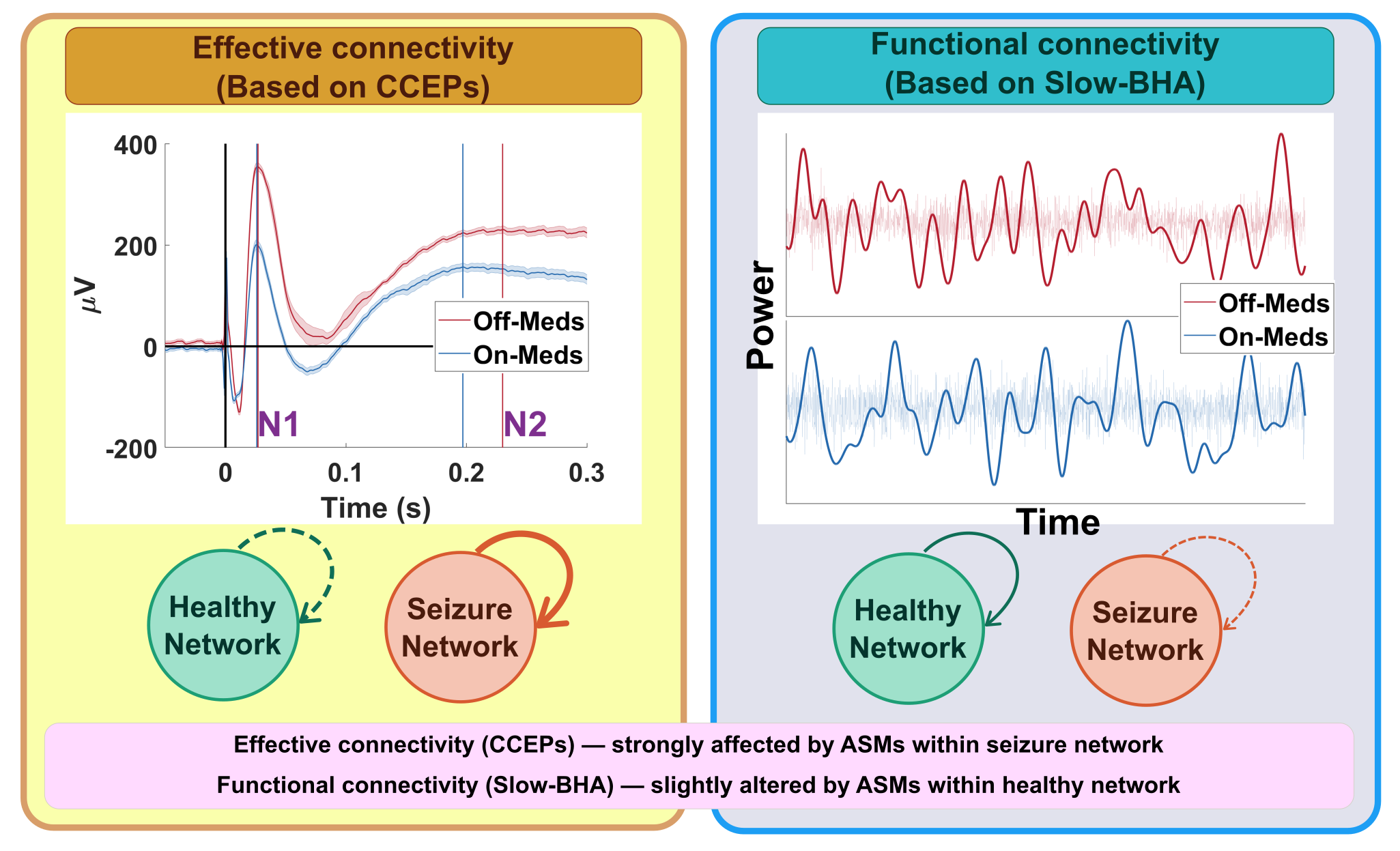
My first research project at UAB! In this unique dataset, we compared the effective connectivity (as measured with cortico-cortical evoked potentials - CCEPs) and functional connectivity (correlations of slow broadband high-frequency activity) when patients with intracranial EEG were on and off their anti-seizure medications (ASM). “Anti-Seizure Medications Alter Functional and Effective Connectivity as Measured With Intracranial Electroencephalography”
As part of the ongoing research projects, patients who had been implanted with intracranial depth electrodes had single pulse electrical stimulations (SPES) to record CCEPs while they are on ASMs. However, some of these patients did not have typical seizures, thus the clinical team decided to record another session to induce seizures off of their ASMs. We used these unique situation to compare effective connectivity in five patients. We also used resting state recordings from a set of overlapping five patients to understand the functional connectivity changes on vs off ASMs.
We recorded a total of 565 bipolar channels and electrically stimulated a total of 17 seizure onset zone (SOZ), 6 early propagation zone (EPZ), 36 irritative zone (IZ), and 64 non-involved zone (NIZ) electrode pairs across five patients. We compared the amplitude and latency of early and late voltage deflections (N1, N2) and root mean square values of CCEPs between two sessions.
We found that ASMs preferentially modulated excitability within the epileptic network, with the highest rates of significant CCEP amplitude changes observed for seizure network (SOZ→SOZ: 15.9% N1, 15.5% N2; EPZ→EPZ: 15.6% N1, 11.1% N2; IZ→IZ: 11.6% N1, 12.4% N2) compared to NIZ→NIZ (5.7% N1, 7.4% N2), and with amplitude effects consistently exceeding latency effects across all tissue class combinations (p < 0.05, group significance at q < 0.05). We also found that the RMS based connectivity and functional connectivity were altered more often outside of the seizure network.
Overall, we found that ASMs altered the effective connectivity within the seizure network more than within non-involved regions, whereas functional connectivity was altered more often within non-involved regions. This study is the first study revealing with high spatiotemporal resolution that ASMs can alter brain effective and functional connectivity in multiple different ways.
This was an exciting research journey during my residency. I had huge support from Dr. Benjamin Cox and Dr. Rachel Smith who trusted me with the data analyses and moving the project forward. It was a pleasure to work with Helen, Bekah and Dr. Vaddiparti as well.